On the final day of the conference, Odoo founder Fabien Pinckaers used a simple analogy to warn against making AI the foundation of a large software system: it's like building a house on quicksand. Two talks on the same day showed what this means in practice, at a packaging company and at a fresh-produce wholesaler.
Why did Fabien Pinckaers warn against building large systems on AI?
On the last day of the conference, Fabien Pinckaers didn't talk about the Odoo product. Instead, he talked about growing a one-person business into a company with 7,500 employees. He said its revenue this year was close to €900 million. He turned to AI towards the end of the talk.
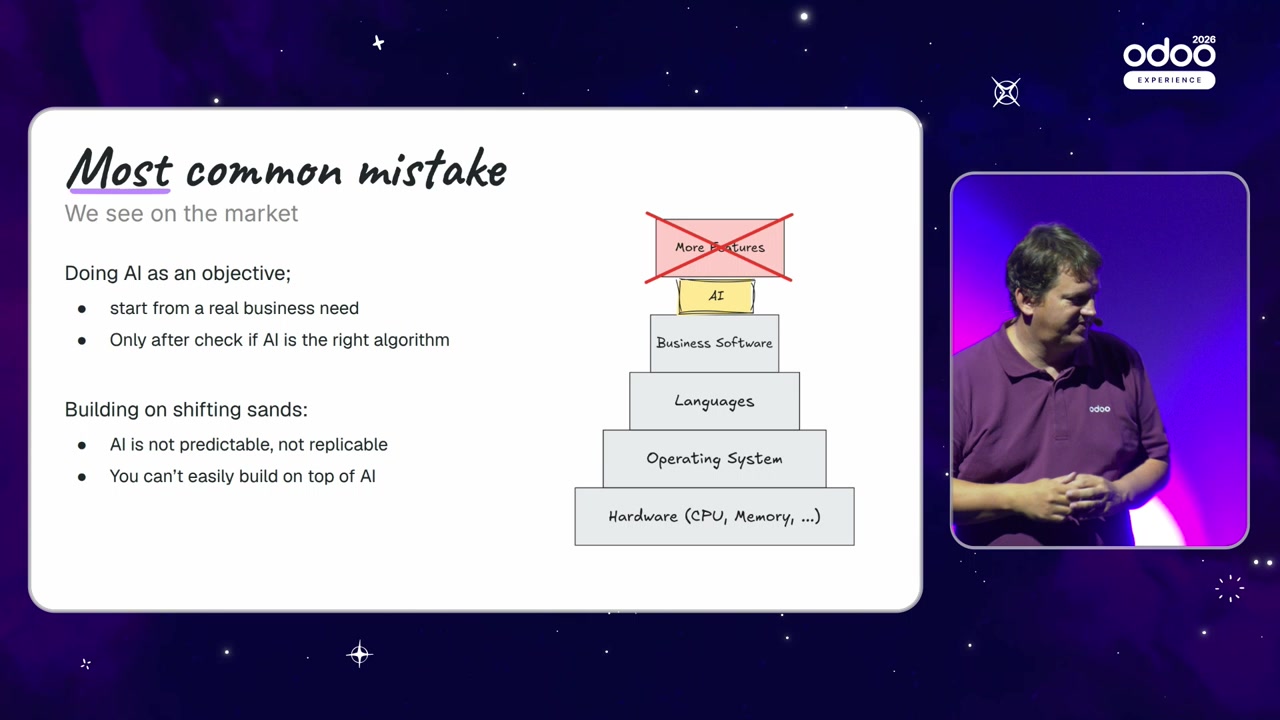
Source: https://www.youtube.com/watch?v=BhQ-WRTVHPg&t=4830
His argument was that each layer of a software system, from the operating system to business applications, can build on the layers beneath it because those foundations behave predictably and consistently. AI, in his view, is different: it can give a different answer to the same question at different times. In his view, that makes AI an unreliable foundation for a large, standalone system, like quicksand under a house. Smaller, well-defined tasks, alongside a stable business system, are a different matter.
His advice to customers: get your existing systems in order first, and only then bring in AI on top of them. He also said that, in his view, AI rollouts at Odoo haven't reduced headcount so far, because demand for their services has grown instead.
I fully agree with this, and it matches my own experience. You need clean, standardised data and clearly defined processes before you add AI. That's exactly why, in an implementation, I only build what's strictly necessary, nothing extra that nobody needs. And for day-to-day work, I think Odoo's built-in AI features are simply good enough.
How does a wine box turn into a quote and a production job?
In the packaging track, French Odoo partner Iro and the company behind HIPE, a packaging pricing tool, showed how an order for wine packaging moves from quotation to production.
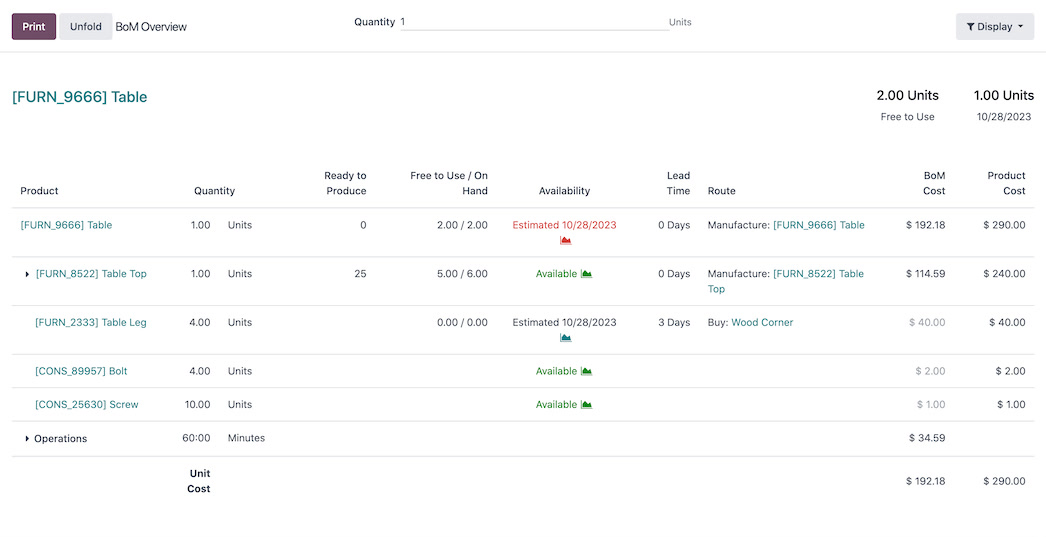
Illustration: the Bill of Materials Overview in Odoo's Manufacturing app. Source: https://www.odoo.com/app/manufacturing
The talk addressed a question a winemaker had asked his partner at an earlier conference: he could track the bottle in the system, but how could he calculate the price of the box and plan its production? They showed the answer using one concrete example: a box sized for six wine bottles, 242×162×280 millimetres, 10,000 units. You also need to choose the board quality, the flute type, the layout on the sheet, the grain direction, and which machine to run it on. According to the speakers, this adds up to thousands of valid combinations, and only a few of them are actually profitable.
At HIPE's core is an optimisation algorithm, not AI. It identifies which configurations the available machines can actually produce. On top of that sits a learning layer that suggests a price based on past data, but the decision stays with the person. Once the customer accepts the price, Odoo automatically creates the product, bill of materials and manufacturing order, and identifies what needs to be purchased. There's no need to enter the same data again.
Order forecasting with machine learning, instead of a chatbot
The third story was a case study from a Belgian Odoo and SAP integrator, about a fresh produce wholesaler that supplies supermarkets. The problem is a familiar one: because the produce doesn't keep long, any bad estimate is risky. Order too little, and you lose sales; order too much, and part of the stock spoils. Before the model was introduced, the company's buyers manually prepared the next day's order every morning, using their own judgement. They also took the weather into account when estimating demand for produce such as strawberries and courgettes.
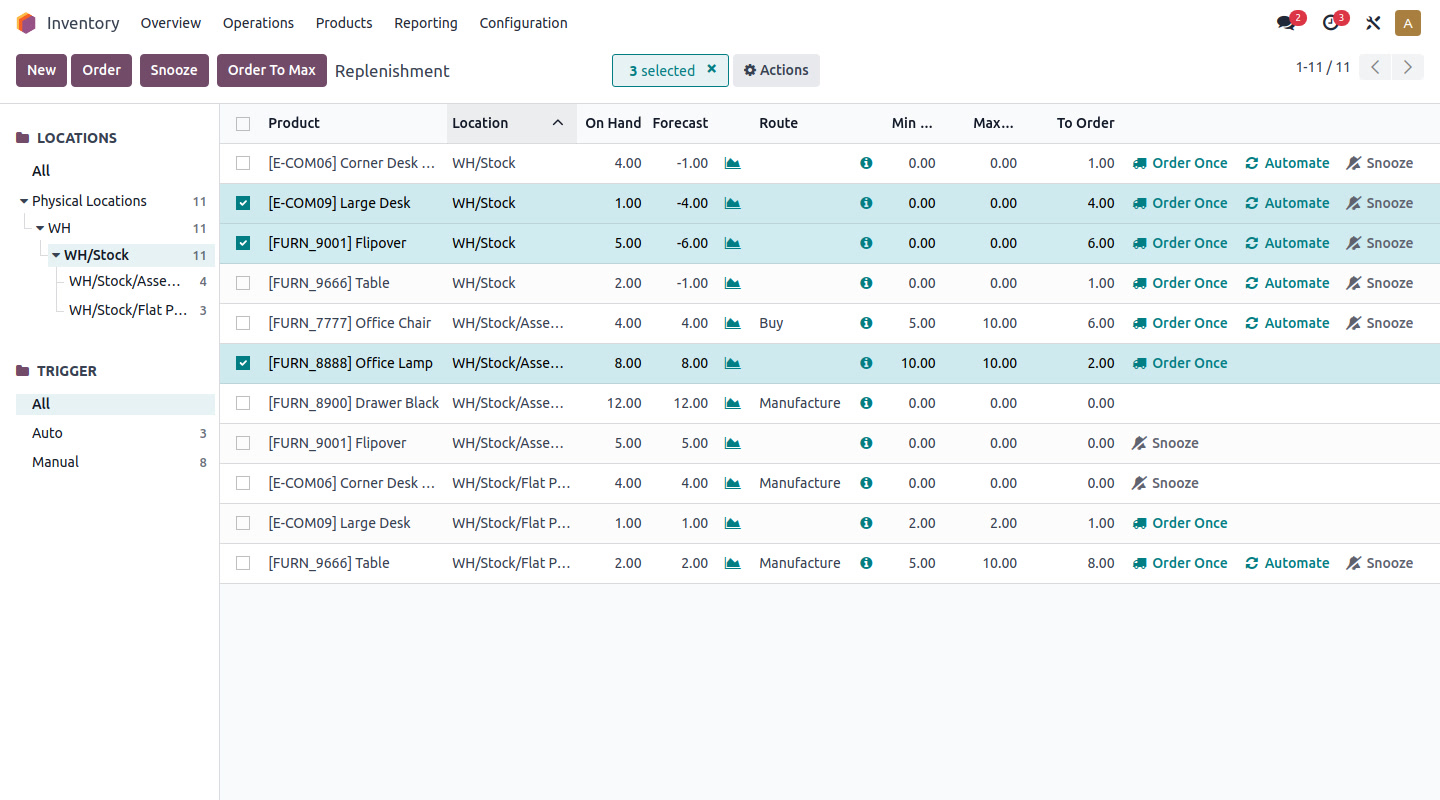
Illustration: the replenishment view in Odoo's Inventory app. Source: https://www.odoo.com/app/inventory
The solution was a forecasting model, trained on the company's past orders and weather data. It runs overnight and, by morning, writes a suggested quantity into every order line; the buyer decides whether to accept it or change it. They deliberately didn't use a language model or a chatbot for this, because those don't always give the same answer to the same question.
The wholesaler's example shows that “AI” often means conventional machine learning used for forecasting. There's no chatbot here: a model fills in a suggested quantity behind the scenes, and a person makes the final decision.
Where should you start?
If you're wondering how AI could help your business, start with a specific task, such as pricing or preparing tomorrow's order, not a vague plan to “bring in AI”.
Is pricing or putting together orders causing you trouble?
Tell me briefly which process is holding you up, and whether you're already using Odoo. I'll go through the situation with you and help you work out what's worth looking into in more detail.
The first consultation is free, with no obligation.
References
- Master Class: Hyperscale, Culture & AI, Fabien Pinckaers, Odoo Experience 2026, Odoo's official YouTube channel: https://www.youtube.com/watch?v=BhQ-WRTVHPg
- From AI CPQ to Shop Floor: Connecting HIPE to Odoo for the Packaging Industry, Odoo Experience 2026, Odoo's official YouTube channel: https://www.youtube.com/watch?v=3LbkhdG-TpI
- How AI transforms ERP into a proactive sales tool: the Jacques Remy case study, Odoo Experience 2026, Odoo's official YouTube channel: https://www.youtube.com/watch?v=SEP_sb1-S6g