If you're picking a business management system right now, you've probably already heard this line: “that'll be in Odoo 20.” Don't base your decision on it. Ask what actually works today instead, and ask for a verifiable example.
I'm Gábor Glázer, and I work on Odoo implementations. I'm not going to predict what lands in Odoo's next major version. I'll walk through what's worth asking your vendor, and show you what a verifiable answer to that question actually looks like.
What's officially known, and what's just speculation
I checked Odoo's official conference page myself. It lists OXP 2026 in Brussels, 24 to 26 September. No release date for the next major version appears there.
I found the additional promises about database architecture and approval workflows in partner blogs, not in an official announcement. I'm not saying they're false. I'm saying they're unverified, and you need to know that before making a purchasing decision.
I'm making this distinction clear because I'll be giving you my own figures in the sections below. Before I do, it's only fair to distinguish what I know from what I've merely heard.
What to ask your vendor if they promise AI
If you're choosing an Odoo partner right now, these four questions can tell you a lot. None of them is meant to catch anyone out. Their whole point is to find out whether your vendor actually uses what they're recommending to you, inside their own company.
- Which version do you run in your own company? Not at your clients' sites. In your own day-to-day work.
- Which AI features have you turned on, and which have you left off? The reasoning behind what's switched off often tells you more than the list of what's switched on.
- Have you built any custom functionality for it, or are you using the standard features? Either one is fine. It just needs to be said plainly.
- If the built-in AI sends data to an external provider, what do you recommend to a client who can't accept that?
If a vendor gives specific answers to these questions, it's worth continuing the conversation. If they point to the next version, ask what works today.
In the sections below, I'll show you the level of detail you can reasonably expect in an answer, using data I measured from my own live system on 7 August 2026.
What a verifiable answer looks like
As of 7 August 2026, I had twelve out-of-the-box AI modules installed on my own live Odoo 19 system, each with a name beginning with an AI prefix. One further stock module that adds AI support runs under a different name; I cover that counting detail in the FAQ below. The twelve cluster around five areas: document handling and accounting, sales, an internal knowledge base, the website, and the core system.
I left three stock AI modules switched off. All three belong to live customer-support chat. I don't currently run customer-facing live chat, so there's nothing for them to serve.
A feature list on its own doesn't say much. It says a lot more when a vendor also shows you what they left off, and why.
Don't take any number on faith, not even mine
The number twelve isn't an eyeballed guess. I queried the system for the list of installed AI modules, and the flawed query returned thirty-three plausible-looking matches, so I checked them one by one.
The search matched the letters “ai” anywhere inside a word, which pulled in every module with those two letters somewhere in its name: email, newsletter distribution, postal mail, the Gmail connector. None of them has anything to do with artificial intelligence.
The real lesson here isn't about me anymore. The faulty query didn't return zero. It returned a plausible number. Zero would have stood out, because it looks suspicious. Thirty-three doesn't stand out, because it's large enough to sound credible and small enough to be believed.
That's why I went through the matches one by one, and twelve modules actually met the criteria. If a vendor gives you a number, it's always fair to ask: where did it come from, and what checks did you carry out?
What I built for myself, and why I don't offer it as a finished product
The stock modules give you a shared foundation. On my system, alongside configuration and data, three custom additions shape how it actually works. I use two of them in my day-to-day work: one manages AI settings, the other was built for the downloadable checklist on the website.
The third one is the important part: I connected Odoo's own query interface to my locally hosted, in-house knowledge base. Odoo's built-in AI features work with an external provider. In my setup, a colleague still uses Odoo's familiar interface, but the answer now comes from a system running locally. Same click, different destination for the data.
I don't offer this as a finished product, because it's built on my own knowledge base and my own processes. At another company, you'd need to separately assess the data sources, the access rights, and which answers you can reasonably take responsibility for.
Three AI agents, including one expert of my own
In Odoo 19, you can give an AI agent a defined task and access, so it works on the system's data within rules you set. On my system, three agents are active: two are stock, and I built the third myself in June 2026, naming it “GI Odoo Szakértő” (“GI Odoo Expert”).
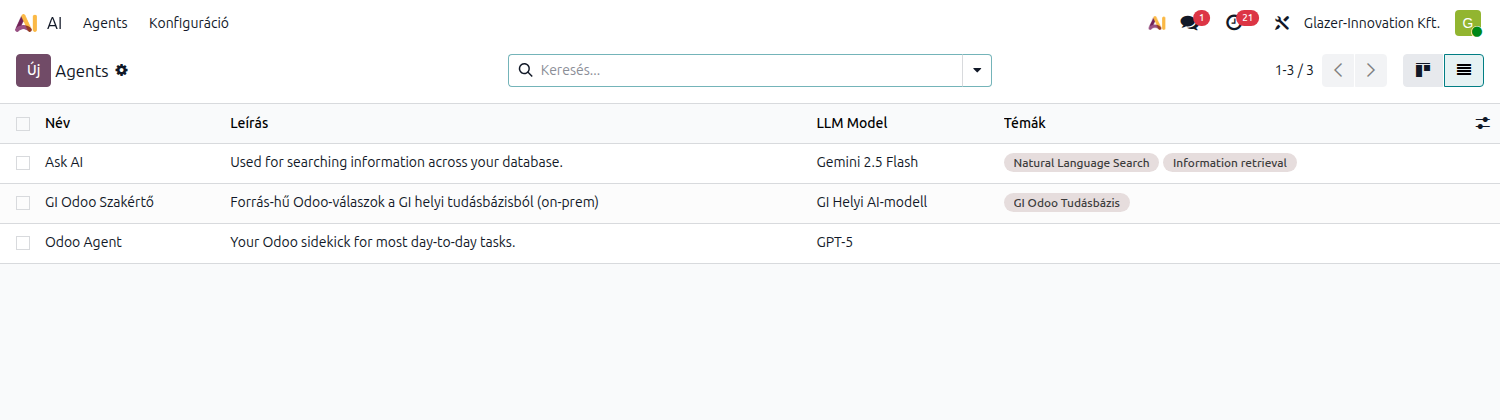
My own Odoo system's agent list. Three agents are running: two are stock, and they use an external provider's model, while I configured the third to use the company's internal knowledge base and a model I run locally. You can see it right there in the image: which agent talks to what.
A colleague can, say, ask about an invoicing setting right inside Odoo's interface, and the answer comes from the internal knowledge base I put together. Unlike a general-purpose chatbot, this agent draws on work I've personally carried out. It's been running for two months and has become a tool I use in my work.
Permissions, tested in a client environment
I can show you how I built this on my own system. That doesn't automatically mean it will work the same way for you. So on one client's live system, I also checked whether the assistant actually respects user permissions.
I requested the same financial summary using two accounts with different permission levels. The account with full access got the summary. The account with restricted access got an error message and saw no financial data at all.
An internal query interface can't be allowed to bypass user permissions. That's something to verify in your own system before any rollout, not assume.
When AI steps outside the conversation
One thing is worth thinking through in advance, because it carries a real risk. In Odoo, an automation rule can trigger an AI feature too, so it can run even when nobody's asking it anything.
You configure this in advance: should the AI produce a suggestion for approval, or be allowed to change data directly? If it runs on its own and can write directly, it'll also run on bad input, with nobody there to catch it. That's a configuration choice, but one you need to make on purpose, not on the fly.
Let's find out which AI layer actually fits your processes. In a free, no-obligation consultation lasting 30 to 45 minutes, I'll discuss a possible first step with you.
What am I doing in September?
I can answer this without making predictions, because it's not about what the system will be able to do in the future. It's about how I work.
I'll wait for the official presentation and read what actually shipped. I test whatever gets released in a separate environment first. Client work runs on my live system, so I'm not experimenting there during the first weeks after a major version change.
In the test environment, I first check what installs and what works with Hungarian settings. Then I separately verify whether a given feature actually holds up in Hungarian accounting practice. That typically takes weeks, not days.
Once I'm done with that, I'll write about it, again including figures and explaining what I left switched off. What I won't promise right now is which feature I'll end up liking. I need to see it first.
FAQ
When is Odoo's next major version coming out?
I'm not claiming there's an official release date. The dates for OXP 2026 are 24–26 September 2026, and the location is Brussels. I'll examine the version actually released in a separate test environment and write about it, again with numbers.
Do you need Odoo Enterprise for the AI features?
For most of them, yes. Of the twelve modules running on my system, ten are Enterprise-licensed, including the built-in query interface, which isn't available on the Community edition. Two are exceptions, running under an open licence. The locally hosted knowledge base itself can run alongside Community too, just not through Odoo's own interface: it needs a separate access point instead. Which route works for you is something an assessment can clarify.
Does our data go to an external AI provider?
Odoo's built-in AI features work with an external provider, so content passed to the AI may be processed outside your company. To handle cases where data must not go to an external provider, I built a custom connection between Odoo's question interface and a locally hosted system.
Did you turn on everything that's available?
No. Three stock AI modules sit switched off on my system, because I don't have a process for them to serve. Turn on what actually has a job to do.
Why twelve, and not thirteen?
There's one more stock module running that adds AI support to the contract-signing process. It's not in the twelve because my query only counted modules whose names begin with an AI prefix, and this one runs under a different name. I'm flagging it because that's exactly the point of this article: a number is only as good as the filter behind it.
When were these figures recorded?
I recorded these figures from my own system on 7 August 2026. Modules can get installed and agents created at any time, so I'll update the numbers when they change.
Let's look at your setup
The numbers from my own system show you the level of detail you're entitled to ask a vendor for. What actually matters for your decision is which process AI would help with in your business, and under what conditions.
Book a free 30-to-45-minute assessment. We'll pick the first process where a realistic business result is likely, and decide whether built-in AI, a locally hosted setup, or plain automation fits it best. We'll then calculate the expected return on investment for that process in detail.
The assessment is free and no-obligation.
Related reading
If you found these findings useful, these three articles explore the topic further:
- AI in Odoo: Practical Examples for Hungarian SMEs six concrete cases where the AI modules genuinely save time.
- EU AI Act 2026: What It Means for Hungarian SMEs Using Odoo (and What It Doesn't) the regulatory side of the permissions and accountability question.
- Odoo Community vs Enterprise: What's the Difference, and Which Does a Hungarian SME Need? AI agents are an Enterprise feature. If you're using Community, the choice between editions is the next question to consider.
Sources
- Odoo Experience 2026 (OXP), practical information, Odoo's official conference page: www.odoo.com/event/odoo-experience-2026-9099/page/oxp26-be-practical-information (accessed: 7 August 2026).