At most companies, access control and time tracking are two separate systems: someone exports the access data every month, manually corrects missing check-outs, and prepares payroll from that. Month after month, that's hours of manual work and a constant source of errors. Access control ERP integration removes this: a card swipe becomes traceable, structured time-tracking data in Odoo automatically — in the same system that already runs payroll preparation, reporting and the rest of the business. I'll walk through a real, working integration (Accessium + Odoo) to show what it looks like, what the actual business value is, what to watch for on the data protection side, and who it's genuinely worth it for.
What is access control ERP integration, and why does it matter?
The question isn't whether the access control system opens the door. It's whether the access event keeps working for your business afterward. Access control ERP integration simply means that access events flow automatically into Odoo and become time-tracking data. That can be card-based access, or — under the right legal and technical conditions — biometric access. So presence data isn't built from spreadsheets, manual exports and end-of-month reconciliation, but directly inside the ERP. At most companies today, access control and time tracking are two separate systems; connecting them removes exactly that manual work and the errors that come with it.
Why is most access control an island today?
An access control system usually does its core job well: it opens the door and records who came in and when. The problem starts because that data stays there — on its own island.
The typical process today looks like this: someone exports the data from the system, moves it into a spreadsheet, manually corrects missing check-outs, and prepares payroll from that. Every step adds a chance of error, and someone spends hours on it every month.
This isn't a technical footnote — it's a business risk. Manual time tracking easily leads to disputes over actual hours worked, payroll cost becomes inaccurate, and producing traceable, auditable data for a labor inspection becomes difficult. When access control and the ERP live separately, the business isn't using the one piece of data that matters most: who was actually present, and when.
From a card swipe to structured time data for payroll preparation
The core idea is a continuous data flow: access → time → payroll preparation. The event created by a card swipe doesn't sit in a separate log — it flows into the same system that already holds the rest of the company's business data.
Connecting attendance tracking with the ERP means:
- In the morning, an employee swipes their card at the reader → an open time entry is created.
- In the afternoon they swipe out → the entry closes, and the system calculates hours worked.
- All of this happens automatically, without manual entry — and every entry is traceable back to a card-based check-in.
From there it's a short step toward automating payroll preparation: structured, verifiable time data is the foundation payroll preparation is built on. One clarification matters here: Odoo doesn't replace Hungary's payroll software — it prepares the underlying time data in a structured, verifiable way that payroll processing then uses.

A working Accessium + Odoo integration — what does the finished solution look like?
This isn't theoretical — I built it. The Accessium access control system's integration with Odoo is a real, working piece of development.
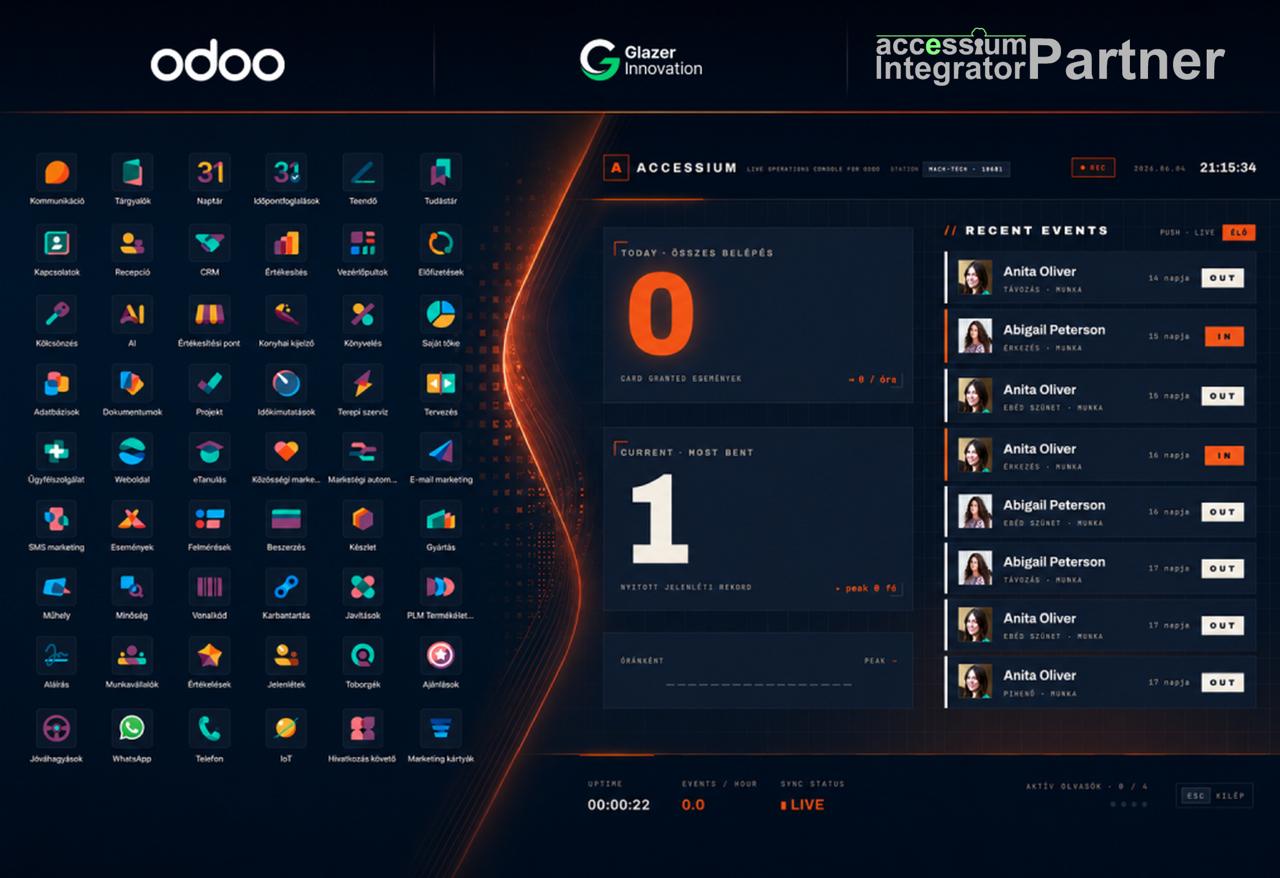
The solution connects Accessium's system — accessible through an API — with Odoo's Attendances module. The technical connection was only the first step. The real work was making the data fit properly into Odoo's time-tracking flow:
- An access card is assigned to an employee in a few clicks.
- Each card swipe automatically creates a time entry in Odoo's Attendances module.
- That data, originating from the card swipe, lands in the same record that management reports, overtime calculations and the monthly close also use — not a separate island, but one shared system.
Here's the real difficulty in a project like this: the access-control side is a security-technology question, and the Odoo side is a business-process and workflow-logic question. I connect the two.
Time-tracking data, payroll preparation, and less administration
This ERP integration isn't valuable for its own sake. The question isn't whether access control can open the door — it's whether the access data keeps working for the business afterward. If someone is exporting, correcting, reconciling and forwarding the same data every month today, the integration isn't a nice-to-have — it's a development that cuts administrative cost.
What a business actually gains from it:
- Less manual data entry. Time-tracking data is created automatically, which reduces the monthly "reconciliation" work.
- A more consistent payroll preparation baseline and better payroll cost control. Payroll preparation starts from measured access events instead of estimates or forgotten check-outs.
- Less monthly administration. Fewer exports, corrections and reconciliations needed for the month-end close.
- One system, one source of truth. Access, hours worked, reporting and overtime all show up in the same place, so there's no "which spreadsheet is current" problem.
Time tracking is also just the first step: once the data lives in the ERP, invoicing, inventory, purchasing, accounting preparation or management reporting can be built on the same foundation later. So this isn't only a technical connection — it means the business keeps building on one shared system, instead of adding another island.

Data protection
Access and time-tracking data — for example, when an identifiable employee checked in or out — typically qualifies as personal data, so how it's processed needs to be defined in advance. Integration here is a compliance question as much as a convenience one.
Technical controls can support GDPR-compliant processing, but they do not establish compliance on their own. The controller must determine and document the appropriate lawful basis, transparency information, retention rules and access controls, with jurisdiction-specific legal review where needed. A well-designed integration can support this technically — for example, encrypted data transfer, logged access and permission management — but the legal basis and required notices always need to be settled separately, as part of your own data protection policy.
If biometric access control is involved, there's an additional layer to consider: biometric data may qualify as special-category data under GDPR, which brings additional conditions on top of the general rules above.
There's also a labor-law angle: employers typically have a legal duty to keep time records. Data recorded in a single system, with a clear audit trail, is generally easier to produce and defend in an inspection or a dispute than manual notes.
Who is this worth it for?
Not every business gets equal value from this. If you only need to manage a handful of check-ins a month, this probably isn't the first thing to build. But if you have multiple shifts, multiple locations, or a lot of manual correction, it's worth running the numbers. A few signs the integration's payback is realistically worth evaluating:
- High access volume / multiple shifts. The more daily card swipes and the more complex the shift pattern, the more manual work automation removes.
- Multiple locations. Where you need a unified view of presence across several sites, a shared system is especially valuable.
- Accurate payroll cost matters. If payroll preparation today is built from spreadsheets and memory, the integration can produce a tangible saving.
- You need auditable data. When traceable presence data that holds up to an inspection matters to you.
- Growth. As the business grows, Odoo isn't a one-off software purchase but an extensible platform — invoicing, inventory or accounting preparation can be built on the same foundation after time tracking.
If you're also weighing which Odoo edition fits your business, that's a separate decision worth its own look — I've written about it in a dedicated comparison of Community and Enterprise.
FAQ — frequently asked questions
What does access control ERP integration actually mean?
It means that access control events (card swipes) flow directly into the ERP and become time-tracking data automatically, without manual entry. Access control and time tracking stop being two separate systems and live in one place instead.
Can any access control system connect to Odoo?
If the access control system is reachable through an API, a database connection or a reliable export, an Odoo integration is generally feasible. I built a working integration for the Accessium system; for a different system, the data connection, permissions and time-tracking logic would need to be assessed first.
Does it work with biometric access control too?
If the biometric access control system is reachable through an API or another standard data connection, the ERP integration is technically feasible. With biometric data specifically, data protection compliance, permission management and a precise processing purpose matter even more — see the data protection section above.
Does this automate payroll too?
The integration produces structured time-tracking data, which is the basis for payroll preparation. Payroll itself can then be prepared faster and with fewer errors from that data, but actual payroll processing still depends on the applicable rules and the payroll solution used — Odoo's value in this flow is producing structured, auditable time data.
What about GDPR?
Access and time-tracking data can be personal data, so processing it needs to be governed. A well-built integration supports encrypted data transfer, logged access and permission management — but the lawful basis and the required notices always need to be settled under your own data protection policy and applicable law.
Is it worth it for a small business?
Payback depends on access volume and process complexity. With multiple shifts, multiple locations, or manual payroll preparation today, it can pay back faster even for a smaller business. A short assessment call can work out the actual numbers for your case.
Let's see if it's worth connecting your access control to Odoo
If access control, time tracking and payroll preparation currently run separately for you, a short, free assessment call is enough to go through your options.
I'm an Odoo Learning Partner — I can handle the Odoo side of the integration, from scoping through development to go-live.
Book a free call with me. In one conversation, we'll go through:
1. Your current system — what access control system you use, and whether it's reachable through an API or export.
2. Integration — how it can connect to Odoo's Attendances module.
3. Payback — where manual administration can be reduced, and where the payback shows up first.
4. Data protection — what GDPR and permission questions need to be settled up front.
The call is free and no-obligation.